Lagos vs Abuja vs Port Harcourt: Where Nigerian Property Prices Are Rising Fastest
[Author bio pending — ask the Realvista team who to credit for these guides]
Nigeria's three biggest property markets are moving in different directions, and the gap between them is widening fast. Lagos remains the country's largest and most liquid market, Abuja continues to offer government-anchored stability, and Port Harcourt, long overlooked, is now posting the steepest projected price growth of the three. For investors, diaspora buyers, and homeowners trying to time a purchase, understanding why each city is moving differently matters more than just knowing the raw numbers.
Here's how the three markets actually compare, city by city, using current listing and forecast data.
Nigeria's Property Market at a Glance
Nigeria's housing shortage remains the single biggest force behind rising prices nationwide. Federal housing data puts the national deficit near 14.9 million homes, and Lagos and Abuja rents remain high enough to support strong returns on well-located apartments and terraces even as prices look stretched in the best districts. Urban migration is compounding the pressure: Nigeria's urban population is growing by roughly 4% a year, adding millions of new city residents and creating relentless upward pressure on housing demand in Lagos, Abuja, and Port Harcourt.
At the same time, macro conditions have started to shift. Nigeria's headline inflation was running at roughly 31–33% year-on-year as of Q1 2026, down from a 2024 peak near 35% but still structurally elevated, while the naira has held broadly stable around ₦1,300 to the dollar through the first half of the year. That combination of cooling-but-still-high inflation plus a steadier currency is a key reason real estate keeps attracting capital as a store of value.
Lagos: The Benchmark Market, Still Expensive but Slowing at the Top
Lagos is the market every other Nigerian city is measured against. With 20–25 million metropolitan residents, it has Africa's most active formal property market by transaction volume.
Current listing data shows just how wide the spread is within the city itself:
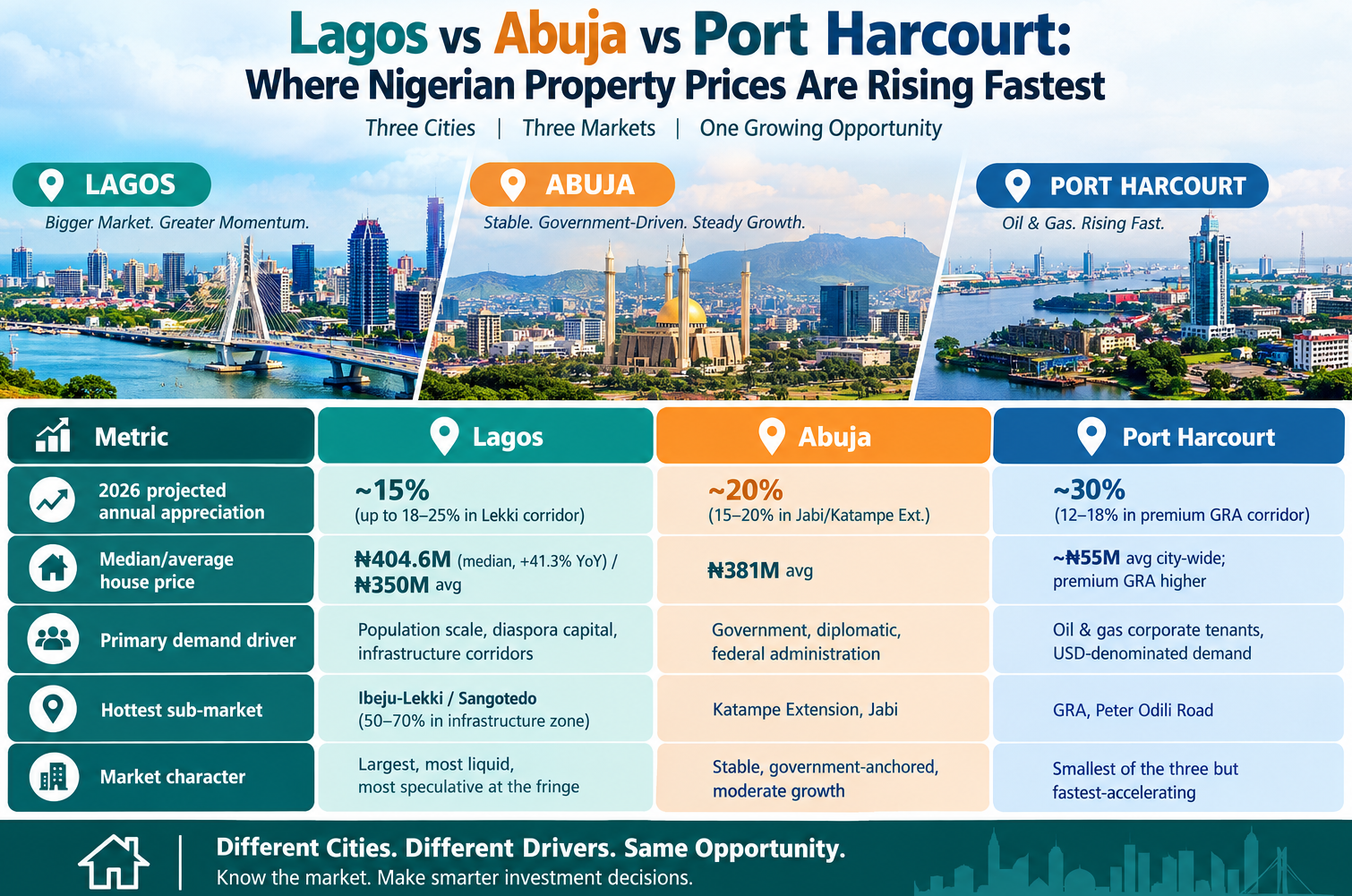
The median house sale price in Lagos sits at ₦404.6 million, up 41.3% year-on-year, the sharpest jump of any Nigerian state this year.
Lagos houses listed on listing platforms (Realvista Properties) average around ₦350 million, while Lagos flats average closer to ₦250–280 million.
At the ultra-luxury end, four-bedroom apartments in Ikoyi and Eko Atlantic trade between ₦900 million and ₦3 billion, having risen 18% in naira terms over the past year, with growth driven mainly by construction cost inflation rather than a surge in buyer demand.
The real growth story in Lagos, though, is happening on the fringes, not in the old prime districts. Land in the Ibeju-Lekki infrastructure corridor within 3km of the Dangote Refinery, the Lekki Deep Sea Port, and the coastal highway is appreciating 50–70% annually, with plots that sold for ₦15 million in 2024 now commanding ₦25–35 million. A verified transaction record shows the pattern clearly: a Sangotedo plot bought for ₦24 million in March 2024 was valued at ₦38 million by January 2026, a 58% gain in 22 months. Meanwhile, Osapa London and the wider Lekki corridor are forecast to post 18–25% price growth in 2026. By contrast, the established luxury core is cooling. Lekki Phase 1 luxury lettings moved only 3–5% in Q1 2026.
Lagos verdict: slower, more mature growth in prime areas; explosive but higher-risk growth in the Lekki-Epe and Ibeju-Lekki fringe.
Abuja: Stable, Government-Anchored, Moderate Growth
Abuja's market behaves differently because of what drives it. As a planned federal capital built since the 1980s, government administration, diplomatic activity, and the federal power structure give Abuja an unusually stable demand base.
Pricing across the city varies sharply by district:
Maitama and Asokoro, the ultra-premium districts, command ₦2.5–6 million a month for a four-bedroom house rent.
Wuse 2 and Garki, the established premium zone, rent a three-bedroom apartment for ₦1.5–3.5 million a month.
Gwarinpa, the mid-tier planned district, offers a three-bedroom apartment for ₦800,000–2 million monthly.
Satellite towns such as Kubwa, Lugbe, and Dutse offer two-bedroom apartments for ₦400,000–1.2 million a month.
On the sales side, listing platforms (Realvista Properties) show Abuja houses averaging about ₦381 million and Abuja flats around ₦158 million. Growth is more measured than Lagos's fringe markets but still solid: 2026 appreciation projections put Abuja at around 20%, ahead of Lagos's projected 15%. Within the city, Katampe Extension and Jabi are the standout growth corridors, forecast at 15–20% price growth for the year.
Abuja verdict: less volatile than Lagos, steady mid-teens-to-20% growth, best suited to buyers who want predictability over speculative upside.
Port Harcourt: The Fastest-Rising Market of the Three
This is where the headline of this comparison actually lands. Port Harcourt has moved from an overlooked, "locked" market to the fastest-appreciating of Nigeria's big three property markets in 2026.
2026 appreciation projections put Port Harcourt at 30% ahead of Abuja's 20% and Lagos's 15%. The reasoning given by local investment officials is that Port Harcourt has more untapped real estate potential than Lagos and Abuja, having been reopened for business after the Rivers State Investment Promotion Agency was set up following the state's Economic and Investment Summit.
The city's demand base is structurally different from Lagos's or Abuja's, which is a big part of why it's accelerating:
Port Harcourt is Nigeria's second-largest property market by transaction volume and value, driven by the country's onshore oil operations, NLNG, offshore oil service bases, and the Bonny Island LNG terminal, generating the highest oil-sector corporate housing demand of any Nigerian city, largely priced in US dollars.
Major oil and oilfield services companies Shell, TotalEnergies, ExxonMobil Upstream, Baker Hughes, Schlumberger, and Halliburton all maintain a significant Port Harcourt presence.
Current pricing reflects corporate-tenant demand:
PH GRA, the premium oil-sector residential district, rents a four-bedroom house for ₦2–5 million a month.
Away from the premium core, Port Harcourt houses average around ₦55 million, ranging roughly ₦30–80 million depending on neighbourhood and quality, while a four-bedroom house in the Eliozu area commands a noticeably higher price.
Momentum in the city's premium segment has been consistent through the year: Port Harcourt GRA prices moved up 4–7% in just the first half of 2026 alone, driven by stable oil-sector corporate housing demand and refinery-related employment growth nearby. Looking further out, the GRA and Peter Odili Road corridor are projected to see 12–18% growth in premium Port Harcourt estates through 2026.
Port Harcourt verdict: highest projected annual appreciation of the three cities, powered by oil-sector tenant demand rather than speculative land banking, arguably a more fundamentals-driven growth story than Lagos's fringe boom.
Which City Should You Invest In?
There's no single right answer; it depends on your goals:
Choose Lagos if you want the largest, most liquid market and you're comfortable with either paying a premium for established prime districts or taking on more risk in fast-growing but less-proven fringe corridors like Ibeju-Lekki.
Choose Abuja if you prioritise stability and predictable, government-driven demand over speculative upside. Katampe Extension and Jabi currently offer the best balance of growth and lower volatility.
Choose Port Harcourt if you want exposure to Nigeria's fastest-projected appreciation rate in 2026, backed by dollar-denominated oil-sector rental demand rather than pure land speculation, though the market is thinner and less liquid than Lagos or Abuja.
FAQs
Which Nigerian city has the fastest-rising property prices in 2026?
Port Harcourt currently has the highest projected annual appreciation rate among Nigeria's three biggest markets, at around 30%, ahead of Abuja (~20%) and Lagos (~15%), driven largely by oil and gas sector corporate housing demand.
Is Lagos still the most expensive city to buy property in?
Yes. Lagos has the highest median and average house prices of the three cities, with a median sale price of ₦404.6 million, and its luxury segment (Ikoyi, Eko Atlantic) still commands the country's highest per-unit prices.
Why is Port Harcourt property growing faster than Lagos and Abuja?
Its growth is tied to dollar-denominated demand from oil and gas multinationals operating in the region, alongside renewed state-level investment promotion efforts that have reopened a previously underdeveloped market.
Where in Abuja is seeing the strongest growth?
Katampe Extension and Jabi are currently the standout growth corridors in Abuja, projected at 15–20% price growth in 2026.
Stay Informed
Get the latest market reports and trends analysis directly to your inbox.
Cookie Preferences
We use cookies to enhance your browsing experience, serve personalized content, and analyze our traffic.