
Property Investment in Nigeria: How Much Do You Actually Need to Start?
[Author bio pending — ask the Realvista team who to credit for these guides]
If you’ve ever searched “How much money do I need to invest in property in Nigeria?” you’ve probably seen different answers. Some say you need millions of naira to get started, while others claim you can start with just ₦50,000. The truth is that both can be right, depending on the type of property investment you choose.
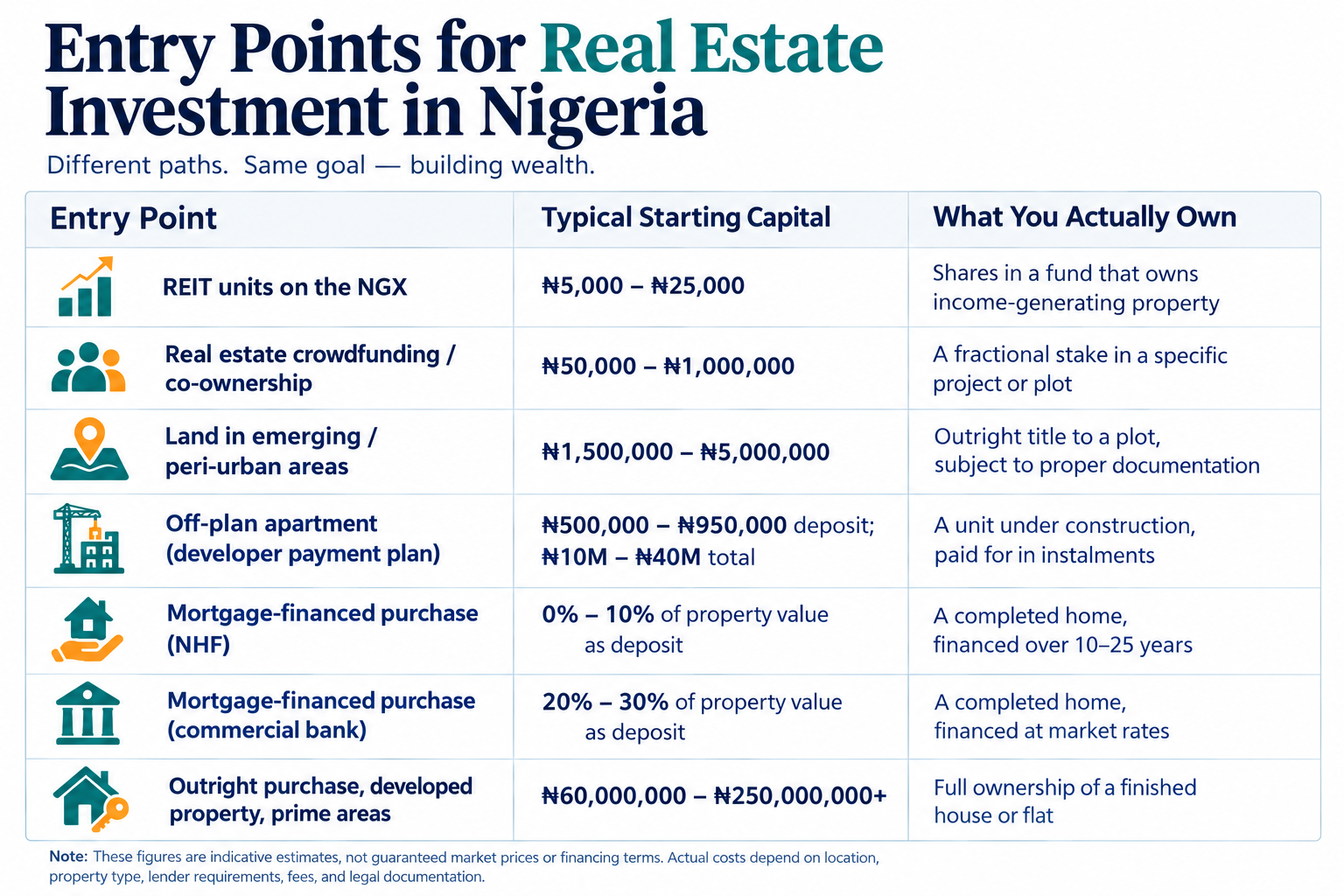
The honest answer is that "property investment" in Nigeria isn't one product with one price tag. It's a ladder with several rungs, and the amount you need depends entirely on which rung you're stepping onto; from buying a fraction of a listed property fund on the stock exchange, to putting a deposit on a plot of land, to financing a full apartment purchase with a mortgage. This guide breaks down each rung with realistic 2026 figures, so you can work out where your budget actually fits.
Route 1: REITs, Real Estate Exposure From a Few Thousand Naira
A Real Estate Investment Trust (REIT) is a fund, listed on the Nigerian Exchange (NGX), that owns a portfolio of income-producing property and is legally required to pay out the bulk of its distributable income to unit holders. Buying into one is functionally the same as buying any other NGX-listed stock: you open a brokerage or CSCS account, and you buy however many units you can afford.
This is by far the cheapest way to have naira-denominated property exposure. Depending on the trading price, a single unit of a Nigerian REIT can cost anywhere from a few naira to several hundred naira, so a starting position is realistically achievable with ₦5,000-₦25,000, subject to your broker's minimum order size.
The trade-off is that you don't own a physical asset; you own a claim on the fund's performance, which moves with the stock market and with the underlying property portfolio's occupancy and rental income. It's liquid (you can typically sell on any trading day) and low-effort. Still, it won't give you the leveraged, land-banking-style appreciation that direct land ownership can produce over a decade.
Route 2: Crowdfunding and Co-Ownership Platforms
Between REITs and buying a whole plot outright sits a newer category: platforms that let several investors pool money into a specific piece of land or a specific development, then split the proceeds proportionally when it's sold or completed. Entry points on these platforms commonly start around ₦50,000, with co-ownership arrangements on higher-value city plots sometimes structured around a ₦1,000,000 minimum stake.
This route can make sense if your budget is too small to buy a plot alone, but you want more direct exposure to a specific property than a REIT gives you. It also carries more due diligence responsibility on your part: platform quality varies widely, and regulatory oversight of these schemes is inconsistent. Before committing money, verify that any platform promising fractional land or property ownership is registered with the Securities and Exchange Commission (SEC) where that registration is required, and ask for the actual title documents behind the specific plot or project, not just marketing material.
Route 3: Buying Land Outright (Land Banking)
This is the entry point most Nigerians picture when they think of "real estate investment": buying a plot and holding it until the surrounding area develops and the value rises. It's also where capital requirements start climbing meaningfully.
In growing but still affordable corridors on the outskirts of major cities, plots can be found from roughly ₦1,500,000 to ₦5,000,000. In more established parts of Lagos or Abuja, land prices climb quickly into the tens of millions. Land banking has genuinely produced dramatic returns for early buyers. Plots bought for a couple of million naira five to ten years ago in areas that later saw infrastructure investment have, in some cases, multiplied in value many times over. But that pattern isn't guaranteed, and it isn't fast. Meaningful appreciation on raw land typically takes somewhere between three and ten years, and land generates no income while you wait.
The bigger risk here isn't the price; it's the paperwork. Nigeria's land sector has a well-documented fraud problem: forged survey plans, disputed titles, and land sold to multiple buyers are common enough that only a small minority of Nigerian landholders hold genuinely clean, registered titles. Before paying for any plot, at minimum:
Verify the title at the relevant State Land Registry (a search will confirm whether the seller is the true, unencumbered owner).
Confirm Governor's Consent has been obtained where required for a transfer.
Use a licensed surveyor to confirm the plot's actual boundaries match what's being sold.
Engage a solicitor to review documentation before you pay, not after.
Route 4: Off-Plan Property
Off-plan buying means paying a developer for a unit that's still under construction, usually via a deposit followed by instalments spread over months or a couple of years. This has become one of the most heavily marketed routes into property in Nigeria, because it lowers the immediate cash barrier: some developers advertise entry deposits as low as ₦15,000,000 to ₦50,000,000, with the full unit price (commonly ₦100,000,000 – ₦400,000,000+ for a modest apartment) paid down over an agreed schedule.
Off-plan can offer real upside; buying before construction is complete is typically cheaper than buying finished, and prices for a delivered unit are often marketed at a significant premium to the off-plan price. But this is also where a lot of Nigerian property money has gone missing. Reports and industry commentary consistently flag developments that stall partway through construction, sometimes for years, leaving buyers with instalment payments made against a project that isn't finished and no straightforward way to get their money back.
Before paying an off-plan deposit: research the developer's track record on prior projects, ask to see the site and current construction stage in person or via a trusted representative, and get the payment schedule and delivery date written into a proper contract, not a WhatsApp message.
Route 5: Buying With a Mortgage
If your goal is to move directly into finished property rather than build up to it through land or off-plan instalments, the amount of upfront cash you need depends heavily on which financing route you use.
The National Housing Fund (NHF), administered by the Federal Mortgage Bank of Nigeria (FMBN), is the cheapest formal mortgage product available to Nigerian workers, and it has become significantly more accessible in recent reforms. As it currently stands, loans of ₦5,000,000 and below require no equity contribution at all, while loans above that threshold up to the fund's higher ceiling require a flat 10% deposit. A sharp reduction from the 20 - 30% previously required. Interest is fixed around 6% per annum, dramatically below market mortgage rates, though eligibility depends on having a documented history of NHF contributions (a statutory 2.5% deduction most salaried Nigerians already pay into), and the loan amount available to any individual depends on their contribution record. A parallel diaspora NHF product now allows Nigerians abroad to access mortgage financing of up to ₦100,000,000 at a preferential rate, applied for and processed largely online.
MREIF, a government-backed fund managed through a primary mortgage bank partner, offers a fixed single-digit rate for loans of up to roughly ₦100,000,000, typically requiring a 10% deposit and open to salaried, self-employed, and diaspora applicants.
Commercial bank mortgages remain the most expensive route: expect to put down 20 - 30% of the property's value upfront, with interest rates running well above 25% per annum given current monetary conditions. On a mid-market property, that combination of a large deposit and a high interest rate makes commercial mortgages genuinely difficult to service on an average salary, which is a large part of why NHF has become the route most financial commentators point beginners toward first, if they qualify.
Route 6: Buying a Completed, Fully Developed Property Outright
This is the most straightforward route on the ladder, no waiting for construction, no payment plan, no financing to arrange. But it's also the one with the widest price range by far, because "completed property" covers everything from an outer-suburb bungalow to an Ikoyi penthouse.
At the entry end, a completed two- to three-bedroom home in developing outskirts like Ikorodu or outer Ajah in Lagos, or Kuje or Lugbe in Abuja, typically runs ₦45,000,000 to ₦100,000,000. Move into established, non-premium neighbourhoods of a major city and a modest, fully finished home generally sits between ₦75,000,000 and ₦200,000,000+, with city averages for a standard flat or house in areas like Lekki, Gwarinpa, or Port Harcourt commonly landing in the ₦150,000,000 - ₦300,000,000 range depending on exact location and finish. At the top end, prime districts like Ikoyi, Victoria Island, Eko Atlantic, and Maitama see 2 - 3 bedroom apartments trading from roughly ₦250,000,000 up to several hundred million naira, and larger detached homes or penthouses in these areas can run into the billions.
Two things are worth knowing before you buy completed rather than off-plan or under-construction:
You pay a premium for "done." A finished unit is typically priced higher than the same unit would have cost off-plan, since the developer's construction and holding risk is already behind them. In exchange, you get to inspect the actual physical asset layout, finishing quality, and any defects before you commit, which off-plan buyers cannot do.
Title documentation quality moves the price. A property sold with a full, registered Certificate of Occupancy commands a noticeably higher price than an otherwise identical property backed only by a survey plan and a deed of assignment. Paying more for clean title is usually the better trade; a discount on a property with weak documentation is not a discount if it costs you the property entirely later.
Costs People Forget to Budget For
Whichever route you choose, the sticker price is rarely the full cost. Depending on the transaction, you should also budget for: legal and solicitor fees, agency/agent commission (commonly a percentage of the transaction value), survey fees, Certificate of Occupancy (C of O) or Governor's Consent processing charges, stamp duty, and for developed property, any outstanding service charges or estate dues. These add-ons can meaningfully increase the effective amount you need beyond the headline purchase price, so it's worth getting an itemised cost estimate from a solicitor before you commit funds.
Where Nigerians Actually Lose Money in Real Estate
The single biggest risk in Nigerian property investing isn't picking the "wrong" entry point on this ladder; it's documentation and developer risk. Land fraud, disputed titles, and stalled off-plan developments are the recurring themes behind most horror stories, and diaspora buyers in particular are frequently targeted precisely because verifying documents from abroad is harder. Whatever amount you're starting with, spend proportionally more time on due diligence than on comparing headline prices: a cheap plot with unclear title is not cheaper than a slightly more expensive plot with clean, verifiable documentation.
Choosing the Right Entry Point for Your Budget
If you're starting with a small amount and mainly want exposure without hands-on management, REITs are the lowest-friction option. If you have a moderate lump sum and are willing to do your own verification work, direct land purchase in an up-and-coming area can offer stronger long-term upside. If you're salaried and have a consistent NHF contribution history, that route can make full home ownership realistic years earlier than a commercial mortgage would. And if you're drawn to off-plan pricing, treat the developer's track record, not the marketing brochure, as the deciding factor. If you have the full amount in hand and want to skip financing and construction risk entirely, buying completed is the simplest route; the trade-off is paying the highest price per square metre on the ladder and needing the largest lump sum upfront.
Frequently Asked Questions
Can I really start investing in Nigerian real estate with ₦50,000? Yes, in the sense that ₦50,000 can get you into a REIT position or, on some platforms, a crowdfunded stake in a project. It won't buy you a plot of land or a mortgage deposit on its own, so it's a starting point on the ladder rather than a route to outright ownership.
Is land banking still worth it? It can be, but it rewards patience and documentation diligence more than timing. Meaningful appreciation typically plays out over three to ten years, and the return depends heavily on whether the area actually develops as expected, something no seller can guarantee.
Is the NHF mortgage actually worth pursuing? For eligible salaried and self-employed contributors, yes. The combination of a low or zero deposit and a fixed rate far below commercial mortgage rates makes it the most affordable formal route to home ownership currently available in Nigeria. The main barrier is confirming your contribution history is up to date and understanding the loan ceiling you actually qualify for.
What's the safest way to invest in property with a small amount of money? REITs carry the least documentation risk because you're buying a regulated, exchange-listed instrument rather than a specific physical asset you have to personally verify. If you want direct property exposure instead, prioritise verified title and a reputable seller over the lowest asking price.
This article is for general informational purposes and does not constitute financial or legal advice. Mortgage rates, REIT prices, land values, and regulatory terms change frequently; verify current figures with FMBN, the NGX, and a licensed solicitor before making any investment decision.
Stay Informed
Get the latest market reports and trends analysis directly to your inbox.
Cookie Preferences
We use cookies to enhance your browsing experience, serve personalized content, and analyze our traffic.